The U.S. food processing industry is a highly competitive market where equipment manufacturers must reach buyers at the right moment and communicate technical value clearly. Food manufacturers, plant managers, engineers, procurement teams, and operations leaders may spend considerable time researching machinery before requesting a quote. For companies selling food processing equipment, being visible during that research process can make a major difference.
A specialized Manufacturing Marketing Agency can help food processing machinery companies build a digital presence around the products, applications, industries, and buyers that matter most. Instead of relying only on traditional sales outreach, manufacturers can use search, educational content, paid advertising, and conversion-focused websites to create a more consistent flow of qualified opportunities.
The opportunity is significant. According to the USDA Economic Research Service, U.S. food and beverage manufacturing plants transform agricultural materials into products for intermediate or final consumption using labor, machinery, energy, and scientific knowledge. Food and beverage manufacturing accounted for 16.8% of sales and 15.4% of employment across U.S. manufacturing establishments in 2021.
Why Food Processing Machinery Buyers Research Online
Buying industrial machinery is rarely an impulse decision.
A food manufacturer considering new processing equipment may need to evaluate capacity, operating requirements, product compatibility, automation capabilities, maintenance, installation, energy consumption, safety considerations, and long-term return on investment.
Different people may also participate in the purchasing process.
An engineer could research technical specifications. A plant manager may investigate productivity and reliability. A procurement professional may compare suppliers, pricing, lead times, and service capabilities. Company executives may focus on investment value and production efficiency.
This means a machinery website needs to answer different questions at different stages of the buying journey.
A product page alone is often not enough. Manufacturers should provide technical resources, application information, FAQs, case studies, comparison content, videos, and clear paths to request information or a quote.
Build a Website Around the Industrial Buying Journey
A food processing machinery website should function as a sales resource rather than simply an online catalog.
Start by organizing products according to how customers search for solutions. This could include machinery type, food application, processing requirement, production capacity, or industry segment.
For example, pages might be developed around:
- Food processing equipment
- Meat processing machinery
- Vegetable processing equipment
- Bakery processing equipment
- Mixing and blending equipment
- Cutting and portioning machinery
- Industrial food preparation equipment
- Custom processing solutions
Each page should explain what the equipment does, who it is designed for, common applications, important specifications, and what makes the solution different.
Strong calls to action are equally important. Instead of forcing every visitor to use a generic “Contact Us” button, provide relevant options such as “Request a Quote,” “Talk to an Equipment Specialist,” “Ask About Capacity,” or “Download Specifications.”
Use Technical Content to Reach High-Intent Buyers
Content marketing can be particularly effective for machinery manufacturers because industrial buyers frequently search for answers before contacting a supplier.
A manufacturer could publish articles answering questions such as:
- How does industrial food processing equipment work?
- What should manufacturers consider when selecting processing machinery?
- How can automation improve food production efficiency?
- What equipment is needed for high-volume food production?
- How do processing requirements affect equipment selection?
- What maintenance practices extend machinery life?
- When should a food manufacturer replace processing equipment?
The goal should not be to publish articles simply to increase website traffic. Content should help potential buyers understand their challenges and move closer to a purchasing decision.
Technical content can also support sales teams. When prospects ask questions during conversations, sales representatives can share relevant guides, case studies, or equipment pages instead of starting every explanation from scratch.
Strengthening Visibility with Local Search
Food processing machinery companies may sell nationally while still benefiting from strong visibility in important manufacturing markets.
Search behavior often includes geographic intent. A buyer might search for equipment suppliers in a particular state, region, or manufacturing hub. Creating useful location-specific content can help manufacturers become more visible to those prospects.
This is where Local SEO For Manufacturers can support a broader search strategy.
Rather than creating thin pages that simply repeat city names, manufacturers should develop useful regional content. For example, a company could create pages explaining how its machinery supports food manufacturers in Texas, California, Wisconsin, Ohio, Pennsylvania, or other important U.S. production markets.
Location-focused pages can include relevant applications, industries served, service capabilities, delivery information, project examples, and genuine customer experience.
Google Business Profile optimization can also support local visibility where appropriate. Accurate business information, relevant categories, reviews, photographs, and consistent company details can strengthen a manufacturer’s local online presence.
Turning Google Ads into a Lead Generation Channel
Organic search takes time, particularly in competitive industrial markets. Paid search can help manufacturers reach buyers who are already searching for equipment or solutions.
The key is to focus campaigns on commercial intent rather than broad industry terms.
For example, searches containing phrases such as “food processing equipment supplier,” “industrial food processing machinery,” “commercial processing equipment,” or specific equipment names may indicate stronger purchasing intent than general searches about food processing.
Campaigns should also direct visitors to dedicated landing pages.
If someone searches for a specific type of processing equipment, sending them to a generic homepage creates unnecessary friction. A relevant landing page can immediately present the equipment, applications, technical benefits, specifications, and inquiry options.
Manufacturers should also track what happens after the click. A campaign that generates traffic, but not qualified inquiries need a different strategy from one that consistently produces RFQs and sales opportunities.
Showcase Expertise with Case Studies and Visual Content
Industrial machinery can be difficult to explain through text alone.
Photos, equipment demonstrations, process videos, diagrams, application examples, and technical illustrations can help buyers understand how a solution fits into their operation.
Case studies are especially valuable because they connect machinery capabilities with real-world problems.
A strong case study could explain:
- The customer’s production challenge.
- The equipment or solution selected.
- How the machinery was implemented.
- The operational improvements achieved.
- Any measurable results that can be publicly shared.
Manufacturers should avoid vague claims such as “best equipment” or “industry-leading technology” without evidence. Specific information is more persuasive to technical buyers.
Connect Marketing with Sales
One of the biggest opportunities for machinery manufacturers is improving the connection between marketing and sales.
Marketing should not be judged only by impressions, rankings, or website sessions. The more important question is whether marketing is producing the types of opportunities the sales team wants.
Useful metrics include:
- Qualified inquiries
- RFQs
- Quote requests
- Product-page engagement
- Organic leads
- Paid-search leads
- Cost per qualified lead
- Conversion rate
- Sales-qualified opportunities
- Revenue influenced by marketing
CRM tracking can help companies identify which campaigns, pages, and content assets contribute to actual opportunities.
This creates a feedback loop. Sales teams can identify the questions prospects ask most often, while marketing can turn those questions into new content and landing pages.
Practical Steps for U.S. Food Processing Machinery Companies
Manufacturers do not need to redesign their entire marketing operation overnight.
Start with the fundamentals.
1. Identify your highest-value products.
Determine which machinery lines, applications, and solutions have the strongest commercial potential.
2. Define your ideal buyers.
Document the industries, company sizes, locations, job roles, and purchasing needs you want to reach.
3. Improve important product pages.
Add specifications, applications, benefits, images, technical documents, FAQs, and clear inquiry options.
4. Build useful educational content.
Answer the technical and purchasing questions your sales team hears most often.
5. Create targeted landing pages.
Develop pages around equipment categories, applications, industries, and high-value geographic markets.
6. Measure qualified opportunities.
Connect website forms, analytics, advertising platforms, and CRM data whenever possible.
7. Review performance regularly.
Identify which keywords, pages, campaigns, and content produce meaningful buyer engagement and inquiries.
Creating Sustainable Growth in the U.S. Food Equipment Market
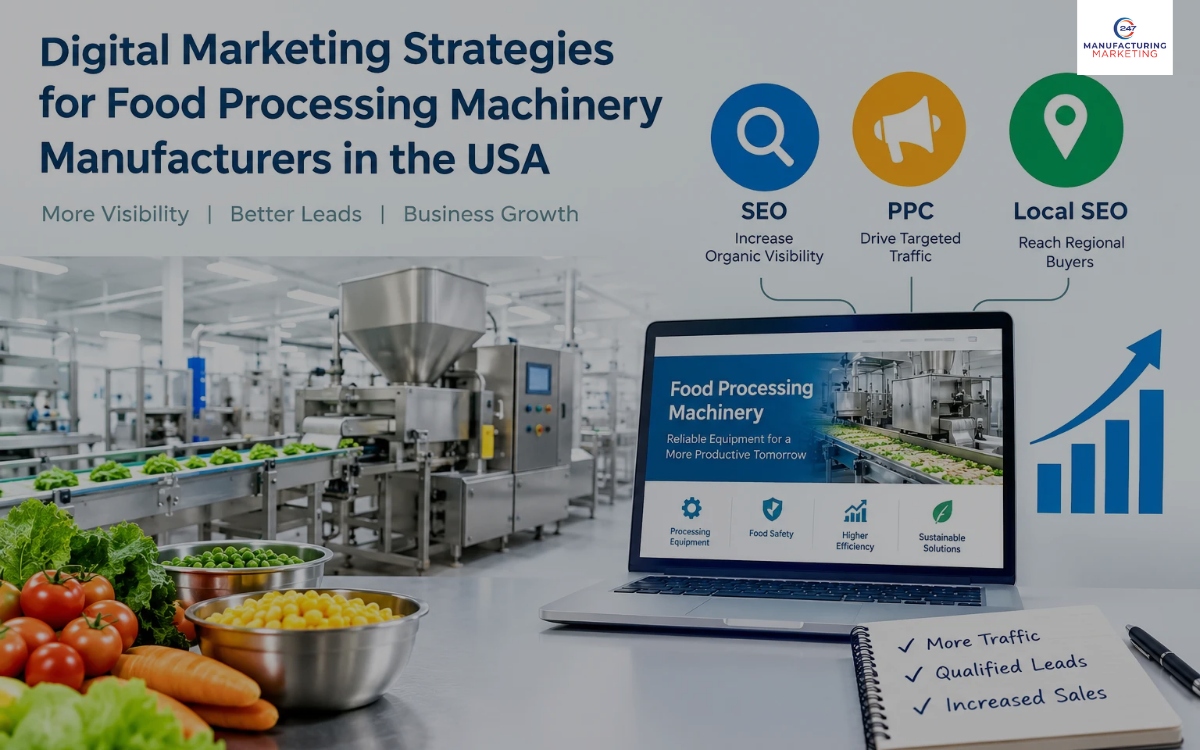
The strongest digital strategy for a food processing machinery company is not built around one marketing channel. SEO can create long-term visibility, content can educate buyers, paid search can capture immediate demand, and a well-structured website can turn that attention into inquiries.
For manufacturers serving the U.S. market, the real advantage comes from connecting these activities around the way industrial buyers make purchasing decisions.
A Manufacturing PPC Agency can help complement organic search efforts by targeting high-intent searches, building dedicated campaigns, testing landing pages, and measuring the quality of incoming leads. The objective should always be more than generating clicks, it should be generating relevant conversations with companies that have genuine equipment requirements.
Food processing machinery manufacturers that combine technical expertise with a clear digital strategy can create a stronger path from online discovery to sales opportunity. By understanding their buyers, answering important questions, showcasing real capabilities, and continuously measuring performance, manufacturers can build a digital presence that supports long-term growth across the U.S. market.
Conclusion
The U.S. food processing machinery market presents strong opportunities for manufacturers that can connect with buyers before they reach the purchasing stage. A well-structured digital presence helps equipment companies explain their capabilities, answer technical questions, demonstrate real-world value, and make it easier for prospects to request information.
Success comes from combining useful content, strong product pages, search visibility, targeted advertising, local presence, and measurable lead-generation processes. Manufacturers should continuously evaluate which channels and content generate meaningful engagement and qualified opportunities rather than focusing only on website traffic.
By building a marketing strategy around the needs of engineers, plant managers, procurement teams, and decisionmakers, food processing machinery companies can create stronger relationships with prospective customers and establish a sustainable source of business opportunities across the United States.